From Bi Sheng to artificial intelligence: what our trip to China brought us
In his own words, Zoltán Kanovits shares his visit to Printing South China 2026, the statue of Bi Sheng, his presentation in Shanghai and unexpected encounters with people from the printing community.
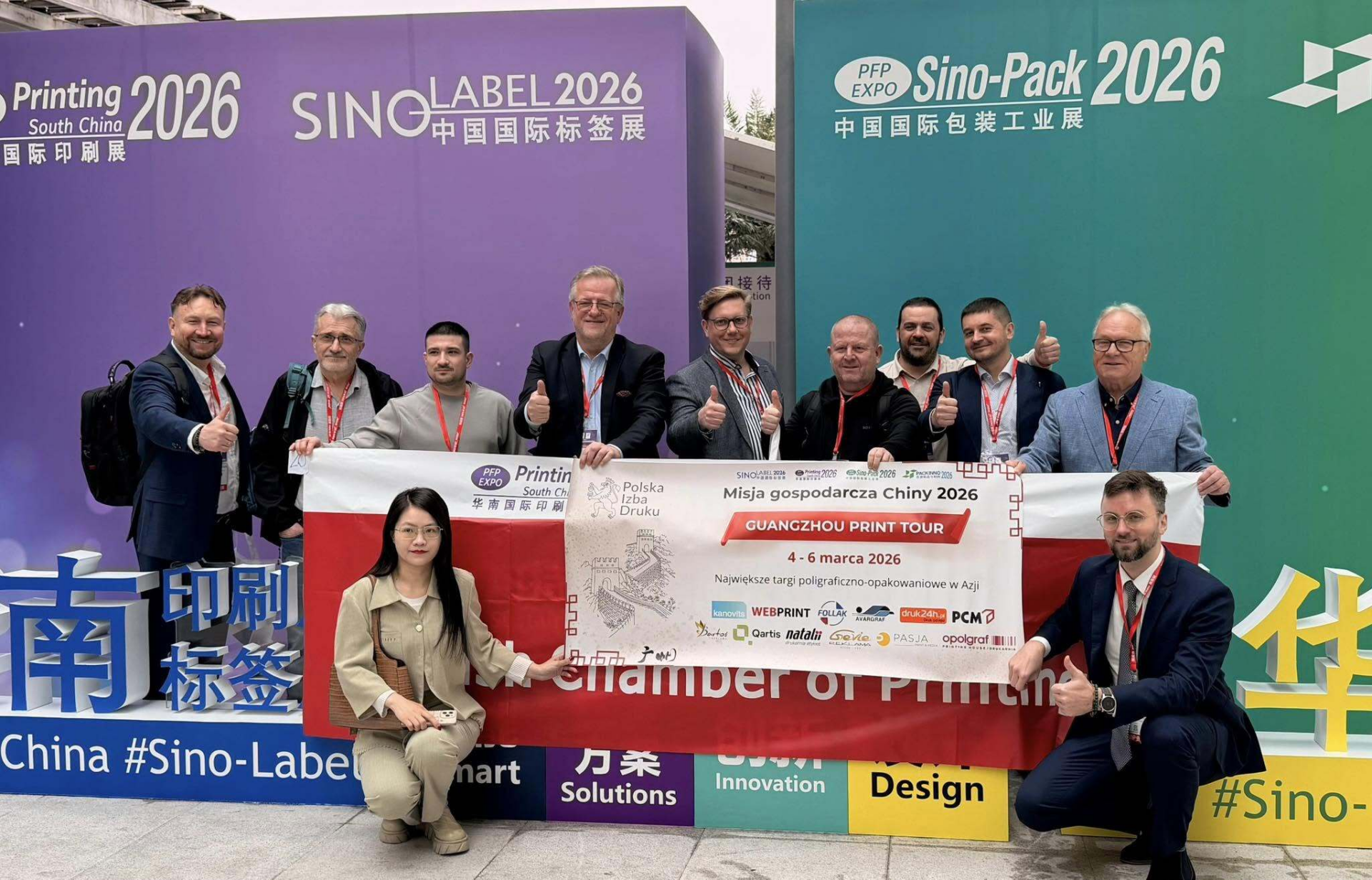
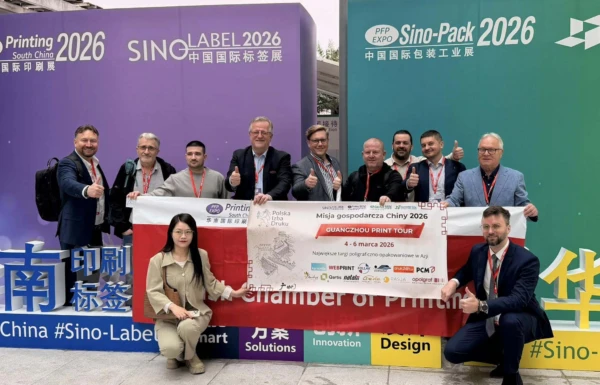
Zoltán Kanovits on his business trip to China in March 2026.
In the coming days, I will be looking for inspiration, technologies and solutions in Asia that can help us build a real competitive advantage at home. That was the thought I took with me to Guangzhou. The global market is not a distant concept. Those who follow developments closely can respond sooner.
The trip combined Printing South China 2026 with a presentation at a Business Forum in Shanghai. It brought new ideas and encounters that reminded me how our industry is shaped by technology, history and, above all, people.
Guangzhou: new knowledge to bring home
At Printing South China 2026, I joined an international delegation organised by the Polish Chamber of Printing. Together with colleagues from several countries, we explored new technologies, ideas and trends shaping the future of printing and visual communication.
Events like these are always inspiring, thanks to the machines and innovations and also because they broaden our perspectives. The goal is simple: to bring home knowledge and ideas that can help our clients grow and succeed.
Robots among the visitors
At the exhibition, robots were already moving among the visitors. There is a lot of technology like this to be seen in China today, and this field seems to be developing very quickly.
It makes you think about how much AI and robotics might change the creative industries and printing. We live in interesting times.
Bi Sheng: around 400 years before Gutenberg
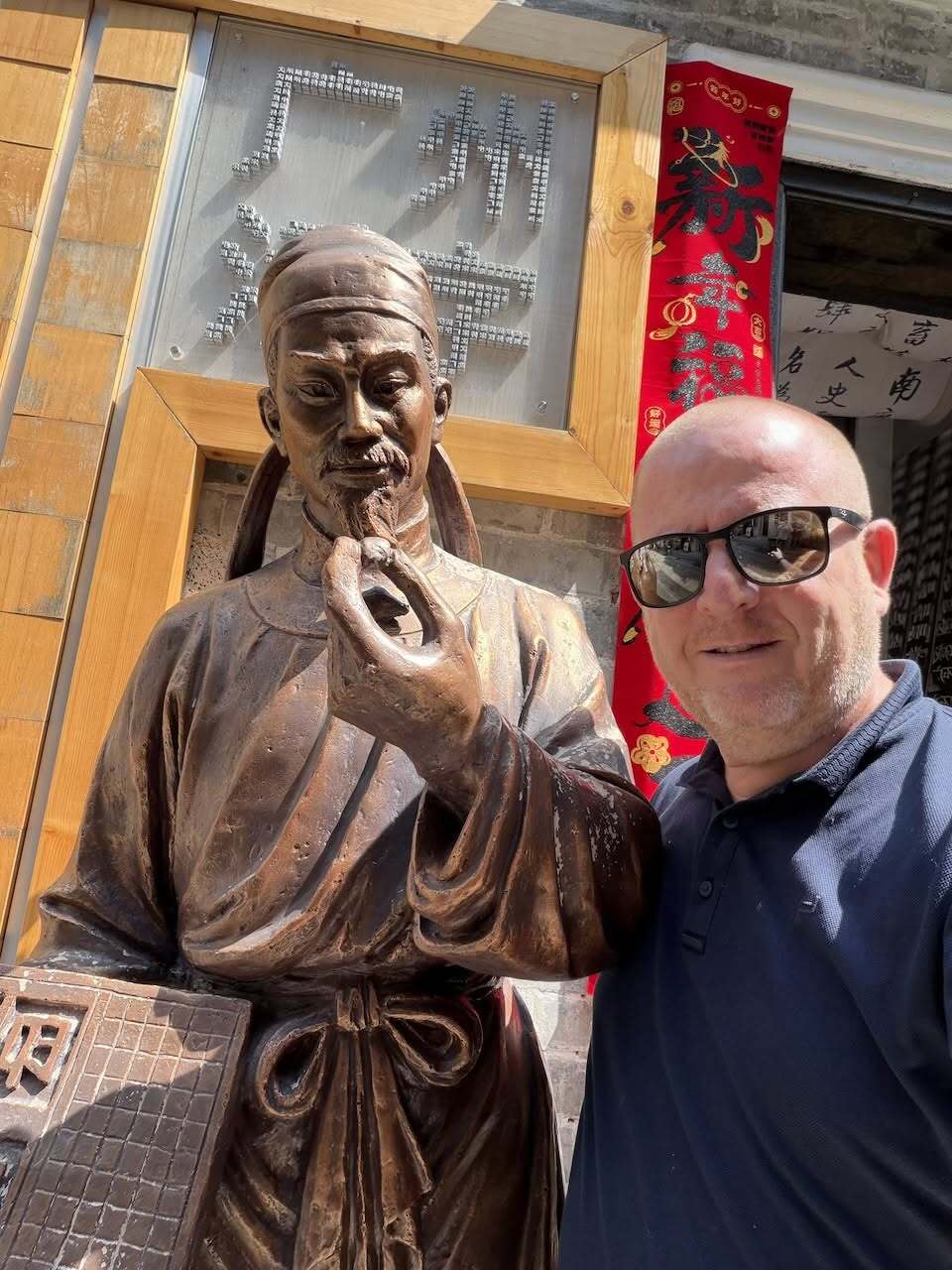
One fact from the history of printing surprises many people: the idea of movable type did not originate in Europe. In Guangzhou, I took a photograph beside a statue of Bi Sheng. It reminded me that, a few months earlier, I had also seen a memorial to him at the Printing Museum of Shanghai Publishing and Printing College.
Beside the statue of Bi Sheng in Guangzhou.
In the 11th century, around 1041–1048, Bi Sheng developed a system of printing with movable type. He worked with individual characters made from fired clay, which could be assembled into pages of text and reused after printing. His invention preceded Gutenberg’s printing in Europe by roughly 400 years.
For someone in the printing industry, it is a special feeling to stand beside a memorial to one of our field’s earliest pioneers. Places like this remind you that China is also a civilisation with a technological and cultural tradition stretching back thousands of years.
Shanghai: design as a language between cultures
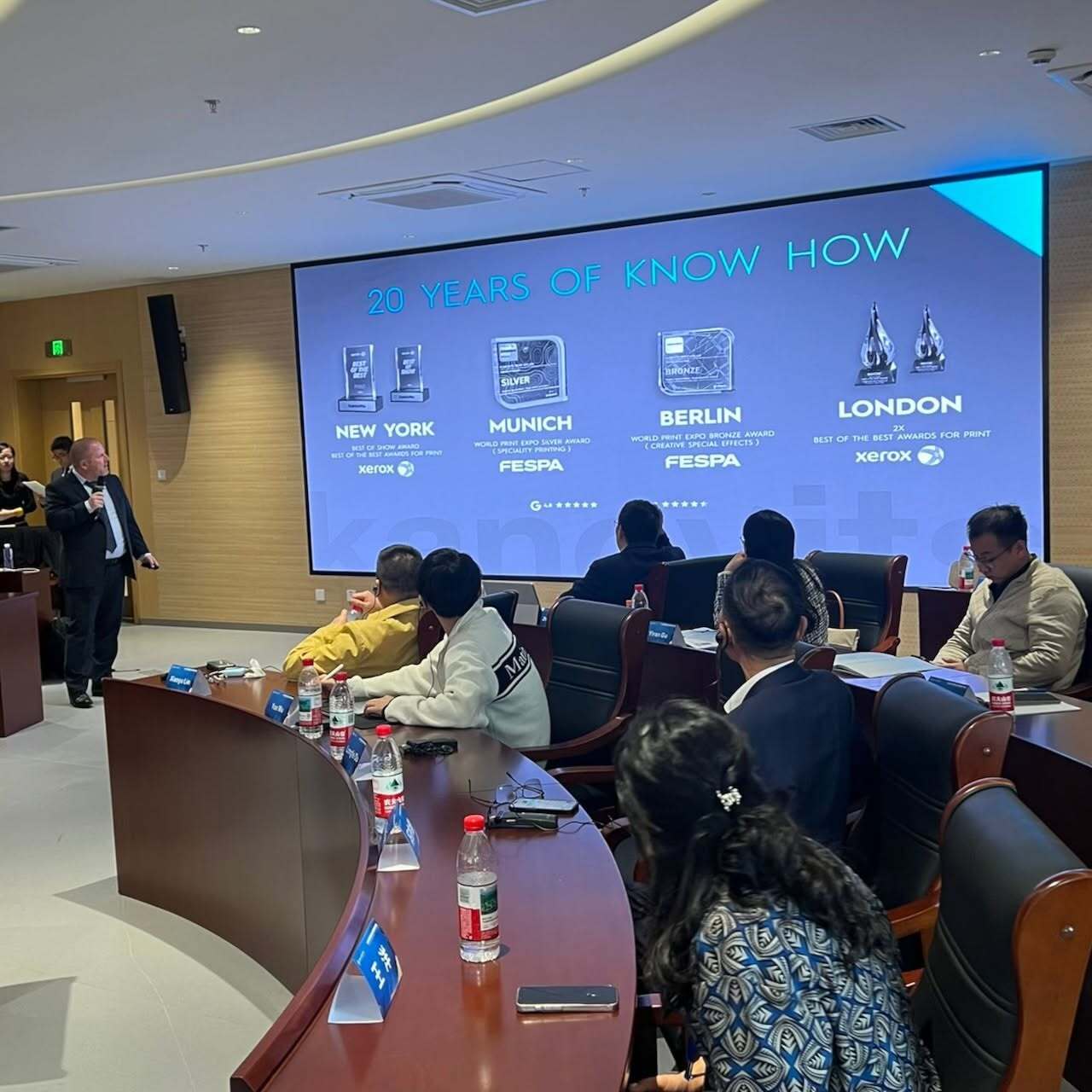
I had the opportunity to present our work at a Business Forum organised by Shanghai Publishing and Printing College. The invitation came through the Polish Chamber of Printing, and I was pleased to represent Slovakia at this professional event. During the forum, I discussed and exchanged experiences with colleagues from China, Poland, Italy and Turkey.
Presenting at the Business Forum organised by Shanghai Publishing and Printing College.
My presentation explored how Chinese brands should adapt to the European market in terms of design and visual communication. What works visually in Asia often communicates differently in Europe. Packaging, branding and printed communication require a different balance between aesthetics, storytelling and cultural context.
Meetings like these are inspiring because printing, design and packaging are also a language that connects cultures and markets across continents.
When someone in Guangzhou calls “Hi Zoltán!”
The world sometimes works in unexpected ways. A few years ago, I gave a presentation at a printing event in Tokyo. Afterwards, a young woman from Thailand came up to me: Nunthanuth Jiaramanytwesin, known as Nat. She told me that she followed our work on Instagram and found our projects inspiring.
Honestly, that surprised me. When you come from a small Central European town like Dunajská Streda, you do not expect people as far away as Bangkok to be following your work.
A year later, at a printing exhibition in Bangkok, I met Nat’s parents completely by chance. I later visited their family company, Image Quality Lab. Her father and I talked at length about printing, and I saw many of the awards their company had won.
Now comes the most interesting part of the story: we had not arranged to meet. I arrive in China for the exhibition in Guangzhou, walk into the hotel restaurant for breakfast, and suddenly someone calls: “Hi Zoltán!” I look up, and there is Nat, this time with her mother. In a country of more than a billion people, in the same city, the same hotel, at the same breakfast.
Meeting Nat from Image Quality Lab.
The smallest cake, one of the warmest memories
It was also my birthday during the business trip to Guangzhou. At breakfast, colleagues from the Slovak and Polish FESPA delegation brought me a small pastry and said: “This is your birthday cake.”
It was probably the smallest cake of my life, but certainly one of the most touching. Although I was far from family and home, it was lovely to spend the day among people who share the same passion for our industry. Sometimes the smallest cake creates the biggest memory.
What we bring back to our work
The purpose of these trips is to bring home knowledge and ideas we can use in our work for clients. From new technologies to design, packaging and conversations with colleagues from other countries, each perspective broadens the possibilities we can consider for a project.
Planning packaging, a company presentation or a print project? Get in touch and we will explore the possibilities together.